
Water Recycling Facility
The Water Recycling Facility at Ironhouse Sanitary District receives wastewater from homes, schools, and businesses in Oakley and Bethel Island. Water is treated through a state-of-the-art filtration and disinfection processes. On the surface the Water Recycling Facility looks like a simple collection of buildings and structures, but hidden behind these walls is a complex of piping and processes designed to turn the wastewater our communities generate into a product that is safe to return to the environment and safe to reuse for irrigation.
Learn more about how the Water Recycling Facility recycles wastewater below.

A. Influent Pump Station: Where raw sewage enters and the treatment process begins.
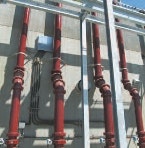
B. Headworks Building: Raw sewage is sent here for a two-stage screening; grit removal and metering by way of drum screens. Drum screens are rotating cylinders that remove solids larger than 1 millimeter, improving operation of downstream equipment and processes.

C. Anoxic/Aeration Basins: Wastewater is now piped to these large holding tanks, which are about 16 feet deep. This is where wastewater is mixed and aerated to allow the biological process to remove soluble matter and nitrogen compounds - these must be removed to protect the environment.

D. Chemical/Blower/Electrical: The air for the aeration basins is supplied by very efficient 300 horsepower, high-speed turbo blowers.

E. Membrane Bioreactor (MBR) Basins: Large pumps lift partially treated wastewater from the aeration basins to the MBR basins, which are suspended growth biological (living organisms) reactors integrated with an ultrafiltration membrane system. The membranes are comprised of thousands of long, hollow, narrow tubes with microscopic pores.
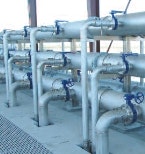
Vacuum Pumps draw the treated water through the membrane pores, leaving solids outside, creating a high quality effluent (treated wastewater that has been cleaned).

F. Ultraviolet Light Disinfection/Effluent Pump Station: Effluent from the MBR basins is disinfected by passing it through channels equipped with ultraviolet (UV) light lamps that expose the microorganisms to lethal doses of UV radiation. After UV disinfection the wastewater is now fully treated and meets the most stringent California Department of Public Health, Title 22, unrestricted reuse requirements.

Fully treated effluent can now be safely discharged by conveying it to an outfall pipe in the San Joaquin River. Recycled water is also available to residents for non-drinking purposes, such as irrigation at the District's Recycled Water Fill Station.
G. Solids Handling Building: Waste solids generated during the treatment process are dewatered and hauled off-site for disposal. The facilities include a solids holding tank, waste activated sludge pump station, solids feed pump station, dewatering belt filter presses and a dual truck bay for temporary storage.
H. Solar Panel Field: The solar photovoltaic system currently on site supports 42% of the energy needs of Ironhouse's Water Recycling Facility. The system was installed in 2013 and is currently providing 1.1 megawatts of solar.